By Beth Fleming, M.S., CCC-SLP
Pediatric Speech-Language Pathologist & Owner, Chatterbox Pediatric Therapy
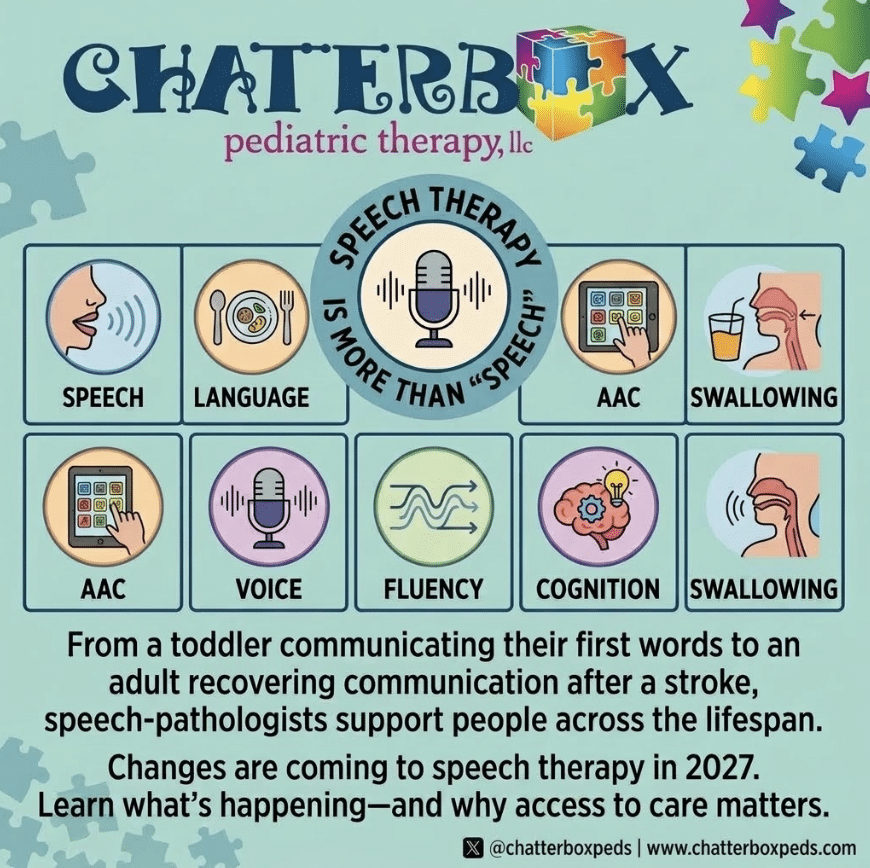
If your child has ever learned to say a new word in speech therapy, used a communication device to tell you what they wanted for the first time, learned to communicate more effectively with others, or finally felt understood after struggling to express themselves, you already know that speech therapy is about so much more than “speech.”
But right now, some significant changes are happening behind the scenes in the way speech-language therapy services will be coded and reimbursed beginning in 2027.
Most families have no reason to know what a CPT code is, how Medicare determines the value of a health care service, or how an insurance company decides what it will reimburse a provider.
And frankly, you shouldn’t have to.
But these decisions can eventually affect something families do care deeply about:
Will speech therapy be available when someone you love needs it?
First, what does a Speech-Language Pathologist actually do?
When most people hear “speech therapist,” they picture someone helping a child learn to pronounce sounds like R or S.
We certainly do that—but it is only one small part of our profession.
Speech-language pathologists, or SLPs, evaluate and treat communication, cognition, feeding, and swallowing difficulties across the lifespan—from babies and young children to adults and older adults.
An SLP may help:
- a toddler learn to communicate their first words;
- a child with autism develop a reliable way to communicate using speech, signs, pictures, or an AAC device;
- a preschooler learn to understand and use language;
- a child with apraxia learn to coordinate the movements needed for speech;
- a school-age child learn to organize their thoughts, understand complex language, or tell a story;
- a child or adult who stutters communicate more effectively;
- someone with a voice disorder regain functional use of their voice;
- a person with cerebral palsy, Down syndrome, or a genetic condition access a communication system;
- an adult recovering from a stroke or brain injury regain language and cognitive-communication skills;
- someone with Parkinson’s disease maintain their ability to communicate;
- or a child or adult with feeding or swallowing difficulties eat and drink as safely as possible.
Speech-language pathology touches nearly every part of life: communicating wants and needs, learning, building relationships, participating in school, maintaining employment, advocating for yourself, eating and drinking safely, and living as independently as possible.
That is why access to these services matters.
So, what is changing?
For many years, speech-language pathologists have used one primary billing code—called CPT 92507—for most individual speech and language treatment.
Think of a CPT code as a label that tells an insurance company what type of health care service was provided.
Beginning January 1, 2027, 92507 will be eliminated and replaced by 10 new treatment codes.
Instead of one broad code covering many types of speech-language treatment, the new system separates treatment into five categories:
- fluency;
- speech sound production;
- language comprehension and expression;
- combined speech and language treatment; and
- voice, upper airway, and resonance treatment.
There will be one code for the initial 30 minutes of treatment in each category and another code for additional 15-minute increments.
There are understandable reasons for modernizing the coding system. Speech-language pathology has changed considerably over the years, and more specific codes can provide better information about the services SLPs actually provide.
The concern isn’t simply that the codes are changing.
The bigger question is how those services will ultimately be valued and reimbursed.
What does “reimbursement” actually mean?
When an SLP provides a covered therapy service and bills an insurance company, the provider generally receives an established or contracted payment for that service.
That payment doesn’t simply pay for the minutes a therapist spends sitting across the table from a patient.
It also helps make the entire service possible.
For an outpatient clinic, reimbursement supports the salaries and benefits of highly trained clinicians, clinical preparation and documentation, caregiver education, collaboration with physicians and other professionals, continuing education, therapy materials, testing materials, AAC technology, sensory and therapy equipment, electronic medical records, billing and administrative staff, rent, utilities, insurance, and all of the other expenses involved in operating a health care practice.
The same basic principle applies in hospitals, rehabilitation centers, skilled nursing facilities, home health, and other settings:
Health care providers have to receive enough reimbursement to continue providing the service.
Why are speech-language pathologists concerned?
The Centers for Medicare & Medicaid Services, or CMS, has proposed Medicare payment values for the new speech-language pathology codes.
Those values are not final yet.
Under the proposal, payment would vary based on the type of treatment being provided and how long the treatment lasts. Some treatment scenarios may be reimbursed differently than they are under today’s system.
CMS has also proposed a separate code specifically for pediatric speech-language pathology treatment. That proposal has raised additional questions about whether the time, resources, complexity, and realities of pediatric therapy are being adequately represented.
There are still important decisions to be made before 2027.
And that is exactly why providers are speaking up now.
“But my child doesn’t have Medicare. Why does this matter to us?”
This is probably the most important question for families.
Medicare does not determine what every insurance company will pay for speech therapy.
State Medicaid programs and private insurance companies establish their own payment and coverage policies, and they are not required to simply copy Medicare’s rates.
However, Medicare is an important part of the larger health care payment system, and providers across the country are now preparing for how Medicaid programs and commercial insurers will implement the new codes.
For pediatric providers like us, that uncertainty matters.
We need to know whether the eventual reimbursement for these services will allow providers to continue delivering high-quality care while paying qualified clinicians appropriately and maintaining the resources necessary to treat patients safely and effectively.
Because when reimbursement becomes unsustainable, what begins as an insurance issue can eventually become something much more important:
an access-to-care issue.
What does reimbursement have to do with access?
Imagine that the cost of operating a therapy clinic continues to rise, but the amount insurance pays for a commonly provided service decreases.
The clinic still has to pay its therapists competitive wages.
It still needs administrative staff, clinical equipment, technology, testing materials, continuing education, insurance, rent, utilities, and countless other resources required to provide care.
Eventually, something has to give.
A private practice may have to limit the number of patients it can accept from a particular insurance plan.
A hospital or rehabilitation facility may have difficulty recruiting or retaining SLPs.
A clinic may have to reduce services.
Some practices may decide they can no longer participate with certain insurance plans.
And in the most serious situations, smaller practices may not survive.
When provider capacity decreases, patients experience the consequences:
longer waitlists, fewer providers accepting insurance, longer drives for care, fewer choices, and delays in medically necessary treatment.
That is why this conversation is about much more than billing codes.
It is about whether people can access care.
Speech therapy isn’t a luxury.
For a child who cannot tell a parent what hurts, communication is not optional.
For a student struggling to understand language in the classroom, language is not optional.
For someone who relies on an AAC device to communicate their wants, needs, thoughts, humor, and personality, communication is not optional.
For an adult recovering from a stroke who is working to speak to their family again, communication is not optional.
For an older adult who is struggling to swallow safely, access to appropriate swallowing care is not optional.
Speech-language pathology can affect whether someone can participate in school, maintain employment, communicate medical needs, develop relationships, live independently, eat and drink safely, and participate meaningfully in everyday life.
These services matter across an entire lifetime.
Why I am speaking up
I have been a speech-language pathologist since 2009 and founded Chatterbox Pediatric Therapy in 2011.
I never imagined that owning a pediatric therapy practice would require me to spend so much time studying federal payment policy, reimbursement formulas, CPT codes, or the processes used to determine how our services are valued.
I became an SLP because I love helping children communicate.
But being both a clinician and a practice owner has taught me something else:
Access to care depends on someone paying attention to what is happening behind the scenes.
It depends on making sure that the people making health care policy understand what these services actually look like in the real world.
It depends on protecting a system in which talented professionals can afford to continue doing this work.
And most importantly, it depends on remembering that there is a person behind every code on an insurance claim.
That’s where families can help.
There are important conversations happening right now about how speech-language pathology services should be valued in 2027 and beyond.
Policymakers can look at data.
They can study reimbursement formulas.
They can review utilization and billing patterns.
Providers like me can explain what it costs to operate a clinic and what it takes to provide high-quality therapy.
But there is something none of those spreadsheets can fully explain:
What speech therapy has meant to your family.
If speech therapy has made a difference in your child’s life—or in the life of someone you love—we are asking you to share your story.
You don’t need to understand CPT codes.
You don’t need to understand Medicare.
And you certainly don’t need to write a perfect letter.
We simply need you to tell us why speech therapy matters.
Maybe your child said “Mom” for the first time.
Maybe they learned to use an AAC device and finally had a reliable way to tell you what they wanted.
Maybe they learned to say their own name clearly.
Maybe therapy helped them make a friend, participate in school, order their own food at a restaurant, tell you about their day, or communicate when something was wrong.
Maybe an SLP helped someone you love regain the ability to communicate after a stroke.
Whatever your story looks like, it matters.
Share Your Speech Therapy Story
Please take a few minutes to complete this parent story form:
We will use these stories to help show Congressional leaders in Washington, D.C., what access to speech-language pathology services means to real people and real families.
Because our leaders will hear plenty about CPT codes, RVUs, reimbursement rates, and payment formulas.
We want to make sure they also hear about the people behind those numbers.
Every person deserves a way to communicate.
Every family deserves access to the professionals who help make that possible.
And sometimes the most powerful thing we can bring to Washington isn’t another spreadsheet.
It’s your story.
Beth Fleming, M.S., CCC-SLP, is a pediatric speech-language pathologist and owner of Chatterbox Pediatric Therapy in Pooler, Georgia. She has practiced as a speech-language pathologist since 2009 and founded Chatterbox Pediatric Therapy in 2011.



Leave a Reply