(That Also Support Development—Without Feeling Like Therapy)
aster baskets are meant to be fun—but for many families, they can feel stressful.
If your child has food allergies, feeding challenges, or sensory sensitivities, the typical candy-filled basket may not feel safe, enjoyable, or even possible. And if your child has developmental differences, you may also be wondering:
“What will they actually use?”
“Will this overwhelm them?”
“Can this support their growth in a natural way?”
The good news—you can absolutely create an Easter basket that feels safe, exciting, and meaningful for your child.
And it doesn’t have to feel like therapy to support development.
🐣 Start with This Mindset Shift
Instead of asking:
“What should I put in the basket?”
Try asking:
“What helps my child feel regulated, engaged, and connected?”
When you build from that place, your basket naturally becomes:
- More enjoyable
- More usable
- More supportive of real-life skills
🧺 5 Types of Easter Basket Fillers That Work for Most Kids
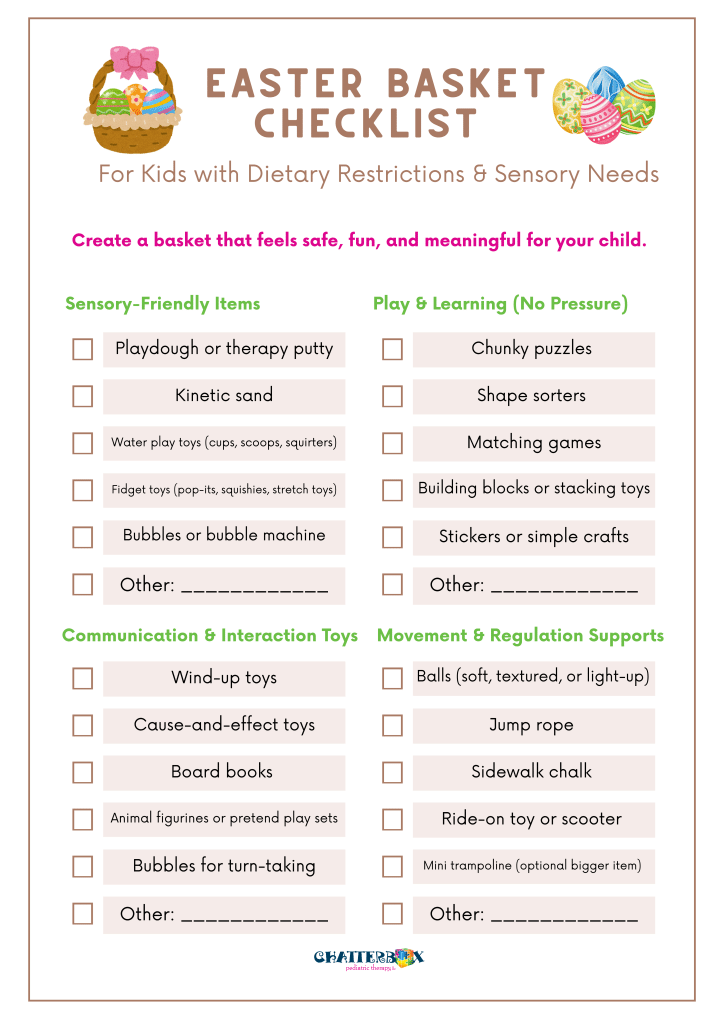
🌈 1. Sensory-Friendly Play Items
These are often the biggest win—especially for children who seek or avoid certain sensory input.
Ideas:
- Playdough or therapy putty
- Kinetic sand
- Water play toys (cups, squirters, scoops)
- Fidget toys (pop-its, squishies, stretch toys)
- Bubble wands or machines
Why it matters:
Sensory play supports regulation, attention, and engagement, which are the foundation for learning, communication, and play.
🗣️ 2. Communication & Interaction Toys
You can support communication without drills—just by choosing toys that naturally invite interaction.
Ideas:
- Wind-up toys (great for “go,” “more,” “again”)
- Cause-and-effect toys
- Simple board books
- Animal figurines or pretend play sets
- Bubbles (great for requesting and turn-taking)
Why it matters:
These toys create opportunities for:
- Requesting
- Turn-taking
- Joint attention
- Early language development
🧠 3. Play & Learning (Without Pressure)
Think open-ended, not performance-based.
Ideas:
- Chunky puzzles
- Shape sorters
- Matching games
- Building blocks or stacking toys
- Simple crafts (stickers, coloring sets)
Why it matters:
These support:
- Problem-solving
- Fine motor skills
- Attention and persistence
All through play—not pressure.
🏃 4. Movement & Regulation Supports
Many kids need movement to feel regulated and ready to engage.
Ideas:
- Mini trampoline (if space allows—great “big gift”)
- Jump ropes
- Balls (textured, light-up, or soft)
- Scooter boards or ride-on toys
- Sidewalk chalk for outdoor movement
Why it matters:
Movement supports:
- Body awareness
- Regulation
- Focus and participation
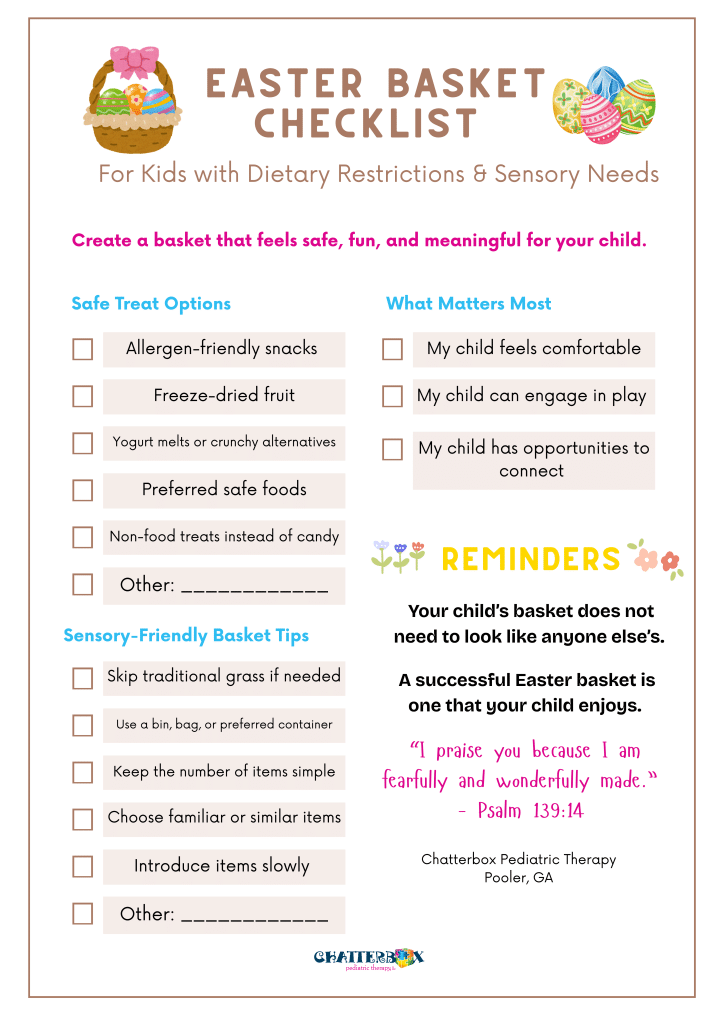
🥕 5. Safe & Inclusive Treat Options
If your child has dietary restrictions, you’re not alone—and there are options.
Ideas:
- Allergen-friendly snacks (based on your child’s needs)
- Freeze-dried fruit
- Pouches or preferred safe foods
- Yogurt melts or crunchy alternatives
- Non-food treats as the primary focus
Important reminder:
It’s okay if your child’s basket looks different.
A joyful experience matters more than meeting expectations.
🐰 Pro Tips for Sensory-Sensitive Kids
A few small adjustments can make a big difference:
- Skip the grass if your child doesn’t like textures
- Use a bin, bag, or favorite container instead of a traditional basket
- Avoid overwhelming with too many items—less is often more
- Stick with familiar or similar items when possible
- Introduce items slowly rather than all at once
💛 What If My Child Isn’t Interested?
That’s okay—and very common.
Try:
- Opening items together
- Modeling how to play
- Following your child’s lead
- Letting them explore in their own time
The goal isn’t a “perfect” Easter moment—it’s connection.
🌼 A Gentle Reminder for Parents
Your child does not need a picture-perfect Easter basket.
They need:
- Experiences that feel safe
- Opportunities to connect
- Play that meets them where they are
And when you choose items that support regulation, interaction, and play, you’re naturally supporting their development—without it ever feeling like therapy.
📍 When to Consider Extra Support
If you’re noticing your child:
- Has very limited food preferences
- Becomes easily overwhelmed by sensory input
- Is not yet communicating wants/needs
- Struggles to engage in play
It may be helpful to talk with a pediatric therapist.
At Chatterbox Pediatric Therapy in Pooler, GA, we use a play-based, neuro-affirming approach to support communication, regulation, and developmental skills—always meeting your child where they are.
🌷 Final Thought
Easter can look different—and still be meaningful, joyful, and fun.
When you focus on what your child truly needs, you’re not just building a basket…
You’re creating an experience that supports who they are becoming.
(You may use this checklist template for your next easter hunt!)



Leave a Reply